From October 12 to 16, the delegation of Lingnan Normal University (LNU) led by Vice President Shao Lexi paid a visit to Lincoln University for cooperation at the invitation of Prof. Andrew Hunter, Deputy Vice Chancellor of Lincoln University, UK. Other five members of the delegation include Jin Yifu, Director of Scientific Research Office, Feng Zongcai, Deputy Director of Industrial Technology Research Institute, Li Zhong, Dean of the School of Physical Science and Technology, Lin Han, Party Secretary of the School of Information, and Chen Chanjuan, Section Chief of Office of International Exchange & Cooperation. The delegation first visited the School of Chemistry, the School of Computer Science and the School of Engineering of Lincoln University, during which the members made extensive and in-depth exchanges and discussions with leaders of Lincoln University as well as heads of relevant secondary schools concerning cultivation of (master and doctoral) postgraduates, laboratory co-construction, professional cooperation and exchanges of teachers and students. Then the two sides signed a memorandum of cooperation and reached a cooperation framework agreement with respect to unmanned vehicle driving, intelligent robots and industrial materials processing. The visit achieved complete success.
On October 13, the delegation was arranged to visit the laboratories of Lincoln University. The first visit was paid to the professional laboratories such as organic chemistry, polymer molding, gas phase analysis and pharmaceutical engineering in the company of Dr. Jose Gonzalez Rodriguez of the School of Chemistry, during which the two sides conducted in-depth exchanges on laboratory construction and maintenance, and discussed the cooperation about analysis of metal and non-metallic materials, R&D of material production processes and quality control methods, as well as ways to develop new materials and analytical instruments.
Subsequently, Michael Gallimore, Deputy Dean of the School of Engineering at Lincoln University, took the delegation to visit the gas turbine training (including actual operation and simulation) workshop, and the Unmanned Vehicle Driving and Control Laboratory jointly built by the School and Siemens, in which he demonstrated the simulation of thermal power plant. Vice President Shao Lexi talked with great interest with students in practical training of gas turbine structure to learn more about how Lincoln University reflects the needs of the service industry and how the “university-local government cooperation” is implemented in the school running. Dean Li Zhong of the School of Physics also made full exchange and discussion about co-establishing the unmanned vehicle lab. It is learnt that the unmanned Vehicle Driving and Control Laboratory has developed the automatic driving technology of the vehicle that controls the braking, steering and other vehicle systems through electronic wire control system. Besides, the driverless electric motorcade is intelligently monitored and managed according to real-time vehicle conditions, road conditions, etc. The Laboratory is currently negotiating with Volkswagen about the details of cooperation. Furthermore, Michael Gallimore introduced the School’s profile, history, curriculum system, development projects, etc. using PPT.
After that the delegation visited the School of Information at Lincoln University. Accompanied by Prof. Yue Shigang, the Director of the Interdisciplinary Laboratory of the School, the delegation visited the laboratories of robot design, control and software programming, during which the two sides exchanged views on intelligent robots in information processing, visual image processing and control optimization. The delegation also conducted extensive and in-depth exchanges and discussions with Dr. David Cobham, Dean of the School of Information, based on the actual situation of LNU and successful practices of the School of Information in industrial research, university-local government cooperation and laboratory co-construction. Eventually, the two sides reached cooperative intentions in scientific research cooperation, teacher-student exchanges and academic achievement sharing in the field of information science.
On October 14, Professor Andrew Hunter, Deputy Vice Chancellor of Lincoln University, met with the LNU delegation. The two sides had deep discussions on the training of (master and doctoral) postgraduates, laboratory co-construction, scientific and technological cooperation, and exchanges of teachers and students. In terms of joint research laboratory, Lincoln University will assist and provide construction planning, major R&D tasks and target requirements, a list of laboratory equipment and technological guidance in artificial intelligence based on the requirements of modern talent training; while LNU will provide the conditions required for scientific research and personnel training, such as experimental sites, equipment, and technical personnel. In terms of (master and doctoral) postgraduates training, the two sides exchanged and explored aspects such as training level, training form, and funding channels. LNU will recommend outstanding undergraduates to pursue the master’s degree at Lincoln University. It’s appropriate to select sophomores or juniors for short-term exchange in the near future, enabling students to experience the charm of each other’s culture and the strength of school-running, and enhancing the university attractiveness to each other’s students. As to the doctoral training, teachers proficient in English may be recommended to study for Ph.D. at Lincoln University, so as to strengthen the relationship, communication and understanding. For the training forms, it is suggested that the young teachers of LNU, after completing the basic research at Lincoln University, return to the laboratory jointly built by LNU and Lincoln University with a degree project to continue the research of the doctoral thesis, thus alleviating the economic burden of teachers and making them complete the academic program smoothly. For the funding channel, both sides may establish disciplinary research projects (or topics) or jointly declare national topics and projects to provide funding assistance to teachers studying for doctoral degree. Lincoln University has now related projects and funds that may satisfy the needs of 1 to 2 young teachers of LNU to study for the doctoral degree. Finally, the two sides signed a memorandum of cooperation and a cooperation framework agreement in unmanned vehicle driving, intelligent robots and industrial materials processing.
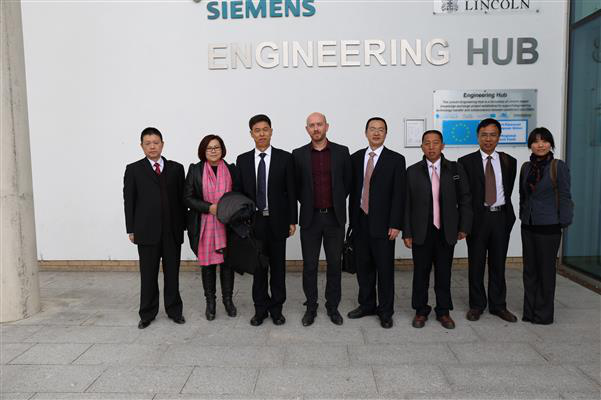
LNU delegation visits Lincoln University, UK
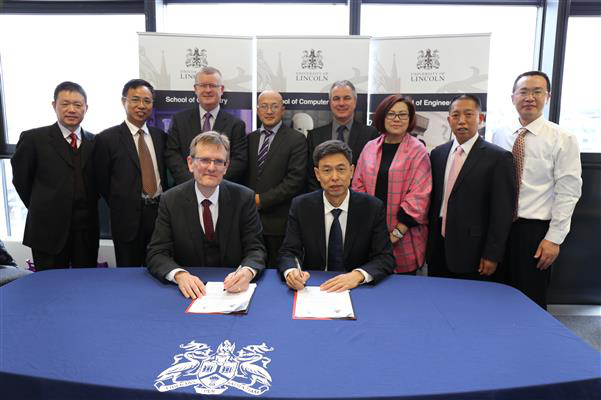
The two sides have a pleasant exchange



